Blue Large-Amplitude Pulsators (BLAPs)
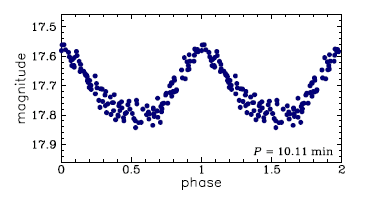
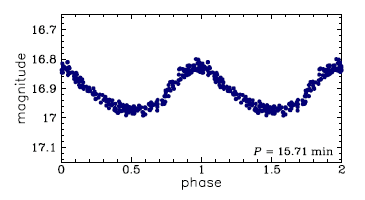
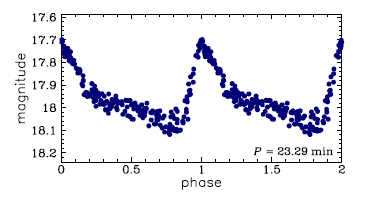
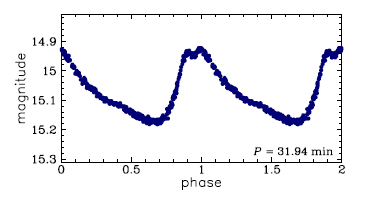
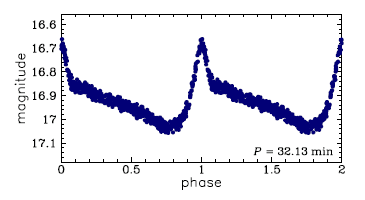
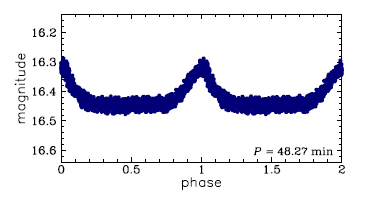
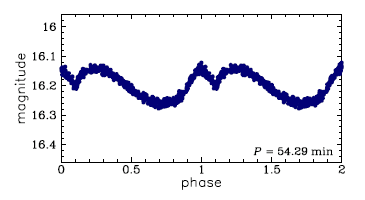
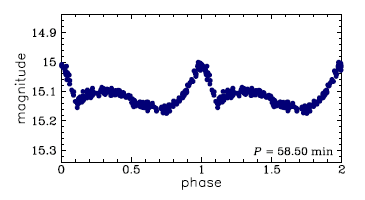
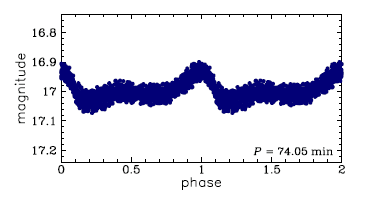
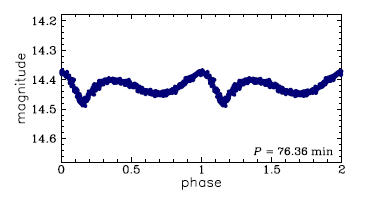
Blue Large-Amplitude Pulsators (BLAPs) are short-period pulsating variable stars exhibiting brightness variations with unusually large amplitudes in comparison to other hot pulsating objects. The first BLAP was discovered serendipitously in the OGLE data for the Galactic disk (Pietrukowicz et al. 2017), but the majority of these pulsators reside in the Galactic bulge (Pietrukowicz et al. 2025). Currently, almost 200 BLAPs are known (Borowicz et al. 2025). The variables have pulsation periods between 3 and 77 minutes and amplitudes up to 0.45 mag in the optical bands. Stars with periods between roughly 20 and 40 minutes show saw-tooth-shaped light curves, similar to those of fundamental-mode classical pulsators, such as RRab-type variables. Pulsators with periods shorter than about 20 minutes exhibit more symmetric light curves. In some BLAPs with periods longer than about 40 minutes, an additional bump appears. In several pulsators with periods between 30 and 60 minutes, there is a dip near maximum, a feature similar to that observed in some RRc-type stars. BLAPs seem to be absent in metal-poor environments like the Galactic halo and Magellanic Clouds.
Multi-periodic stars
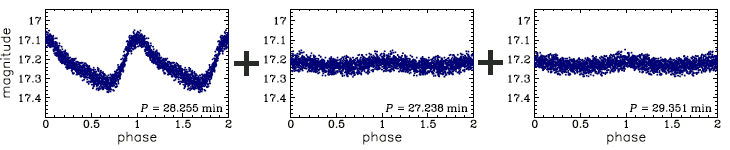
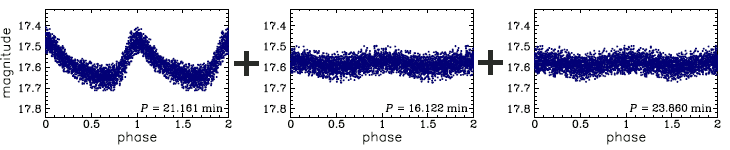
Several known BLAPs exhibit more than one periodicity. In the case of the prototype object, OGLE-BLAP-001, we observe a triplet in the frequency spectrum, being likely a result of rotational splitting.
Object OGLE-BLAP-030 shows three independent periodicities, two of which are likely radial modes and the third one is a non-radial mode.
|